
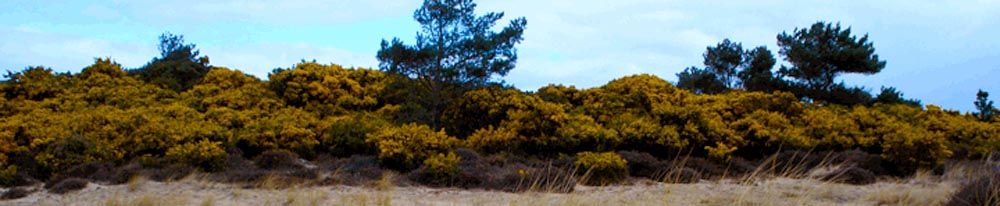
As part of the Findhorn Hinterland Trust’s work to identify the biological diversity that occurs on the 35 hectares of land that we are responsible for managing, I commissioned a spider survey of the site, which took place between the end of April 2019 and the end of August 2022. The survey was carried out using a series of pitfall traps, with two traps being placed at each of 6 sites that were distributed in the various different habitats on the land. I serviced the traps at the end of each month and sent the catches to Edward Milner, a spider expert who very kindly offered to identify the specimens for us. These regular monthly samples were supplemented by occasional individual spiders that I came across and photographed whilst out walking in the Hinterland area.
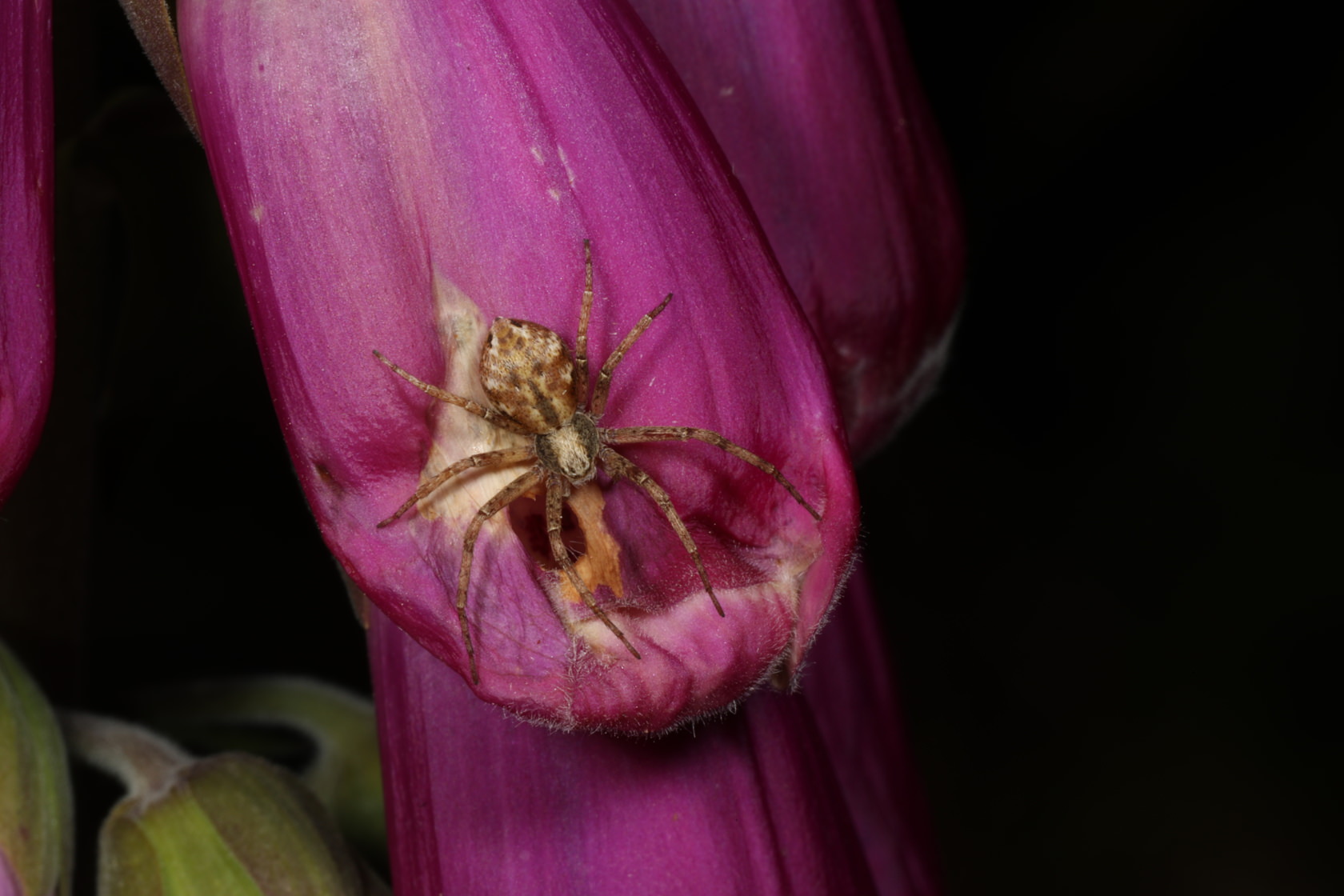
Female spider (Philodromus aureolus) on the flower of a foxglove (Digitalis purpurea) on the Findhorn Hinterland, 1st July 2021.
By the end of October last year, the survey and individual sightings had produced a list with a total of 116 spider species that have been identified on the land we manage. This is quite an impressive range of species, and for the 35 hectares of land it is equivalent to 3.31 species per hectare. By chance, I came across a post on Twitter (https://twitter.com/ecology_digest/status/1586834785233682436) at the end of October which provided some details of the number of spider species that have been found in urban areas of Yorkshire in England. There, they identified 294 species of spiders in a total of 2,500 square kilometres (which is 250,000 hectares). That is equivalent to 0.001 species of spider per hectare – several orders of magnitude less than what we have here at the Findhorn Hinterland.
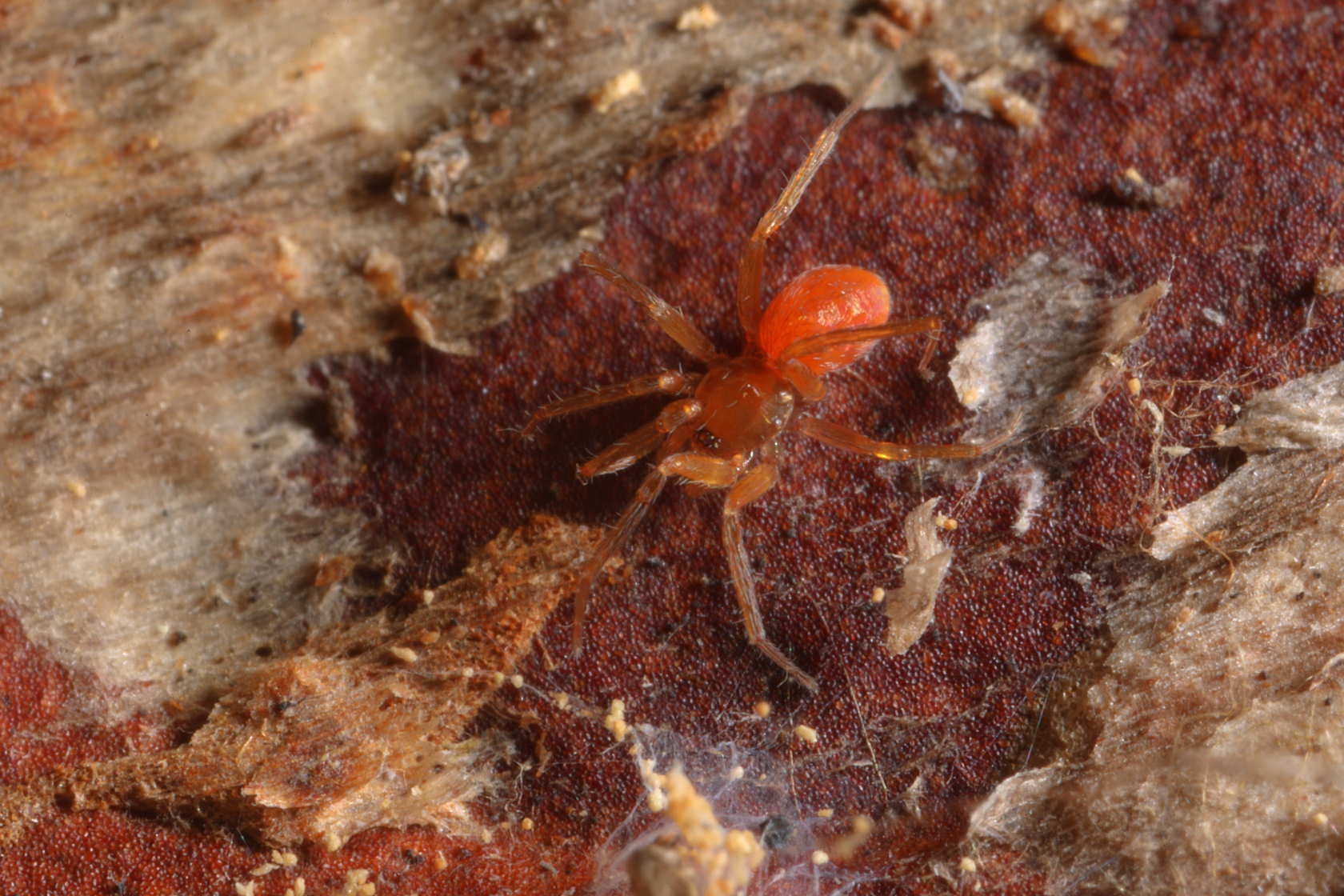
Tiny orange-red female spider (Oonops pulcher) found under the bark of a standing dead Scots pine (Pinus sylvestris) on the Findhorn Hinterland, 28th February 2022.
It can be argued that this comparison is not a fair one, as urban areas do not provide such a good variety of habitats as the more natural landscapes that we have here do. While there is obviously some truth in that, it’s also true that Yorkshire is further south than Findhorn and therefore has a milder climate and so might be expected to support a greater range of species than we have here in the north. What these figures do show though is that here, in our 35 hectares (about 1/7000th of the area of the urban sites in Yorkshire) we have over one third of the species of spiders that they have!
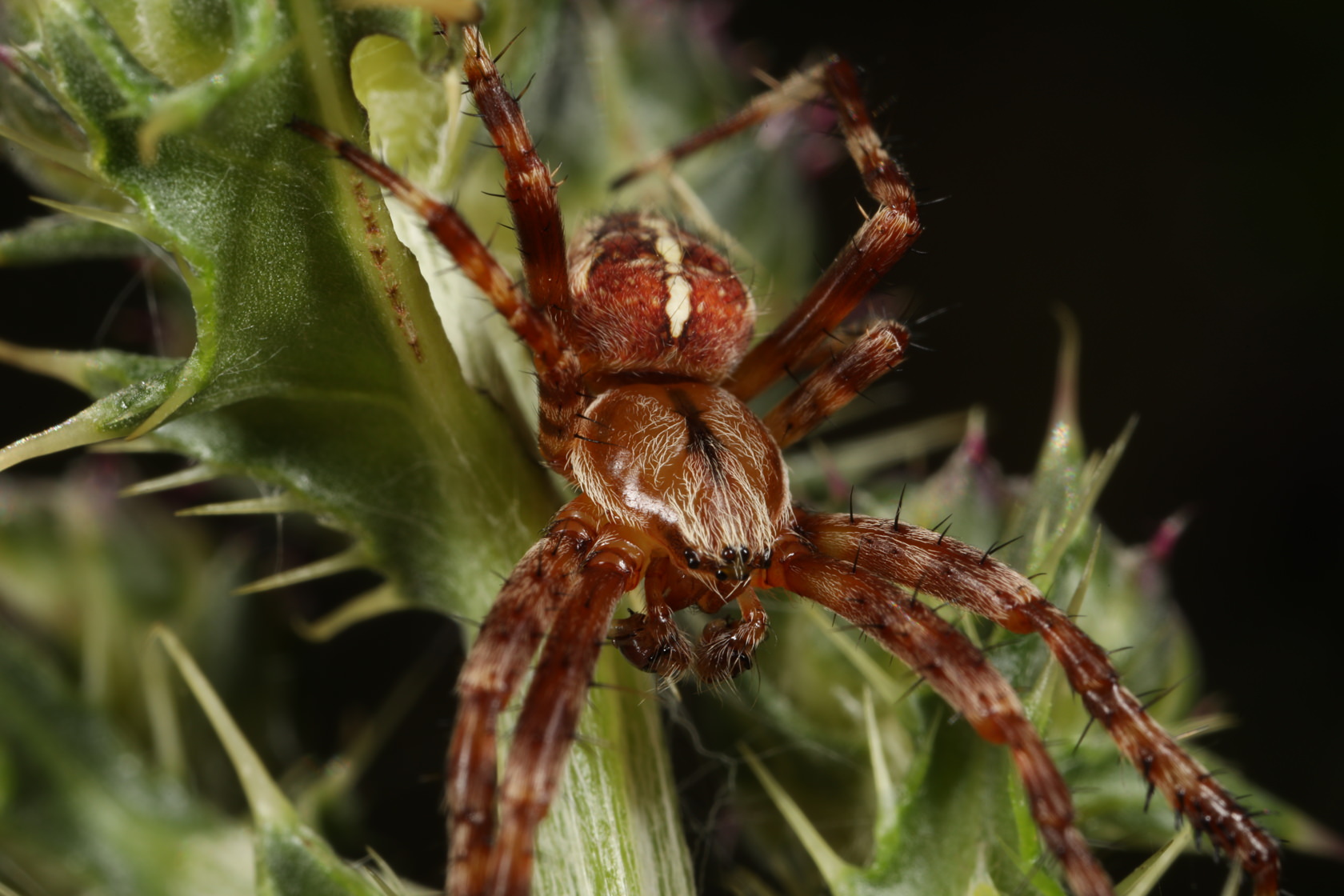
Male garden spider (Araneus diadematus) on a creeping thistle (Cirsium arvense), Findhorn Hinterland, 25th July 2019.
Most of the spiders we have found on the Hinterland are common species, but one in particular was significant. On 9th September 2021 I photographed a crab spider here which was identified as the species, Philodromus praedatus, and this was the first record for this spider north of the Cairngorms in Scotland. Two other notable species found during our survey here are a northern species, Zora nemoralis, which is Nationally Rare, and a wolf spider (Pardosa agrestis), which is Nationally Scarce.
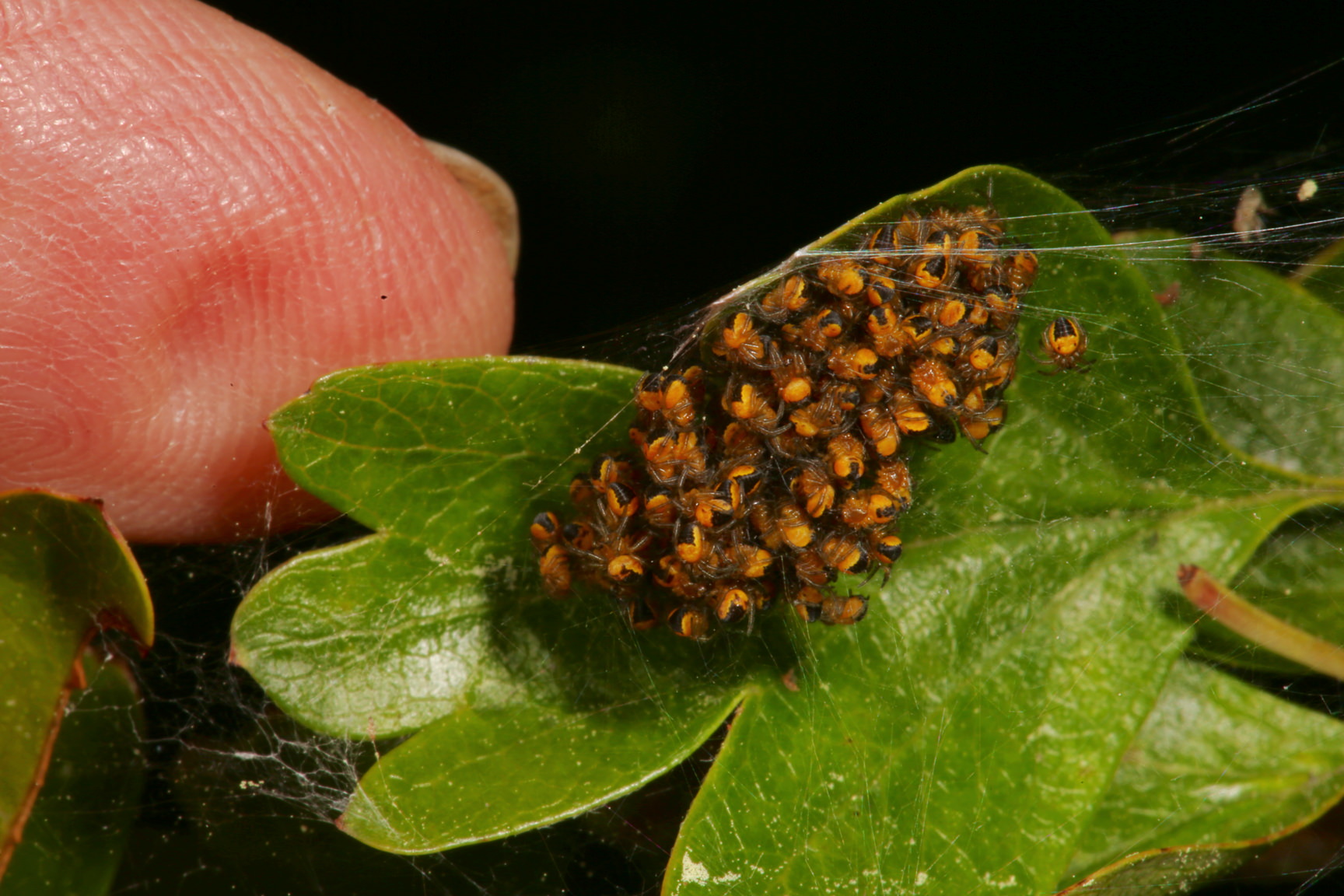
Ball of spiderlings of the common garden spider (Araneus diadematus) on the twig of a hawthorn tree (Crataegus monogyna), with my finger for scale, Findhorn Hinterland, 3rd June 2022.
There are almost certainly more spider species still to be identified on the Hinterland. Pitfall traps, by their very nature, catch spiders that are moving around on the ground. However, many spiders are more arboreal in their lifestyle and seldom go down to the ground, so generally don’t appear in trap catches. Most of the species that I’ve found on the site, and which haven’t appeared in the trap catches, fall into this category. Edward Milner tells me that he has been running a series of spider pitfall traps at a site in London for over 12 years, and is still finding new species when he services them. It seems very likely we’d have the same experience here, so at some stage in the years ahead we may reinstate the traps. In the meantime, I’ll continue to document the spiders that I find by personal observation whilst out on the land.
Alan Watson Featherstone
FHT Trustee & Chair of the Land Management subgroup
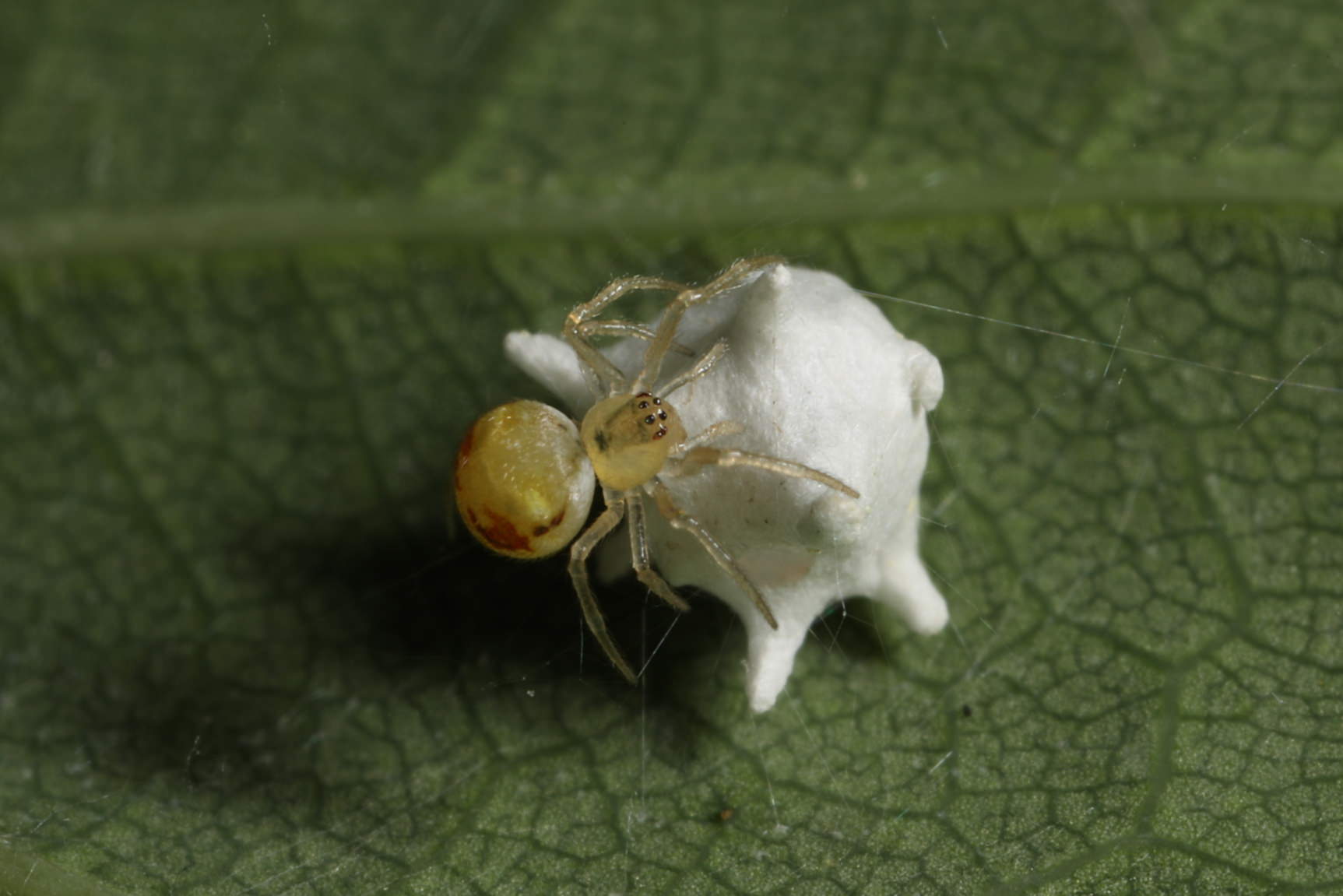
Sputnik spider (Paidiscura pallens) & its egg sac on the underside of an oak leaf (Quercus robur) on the Findhorn Hinterland, 1st August 2022.
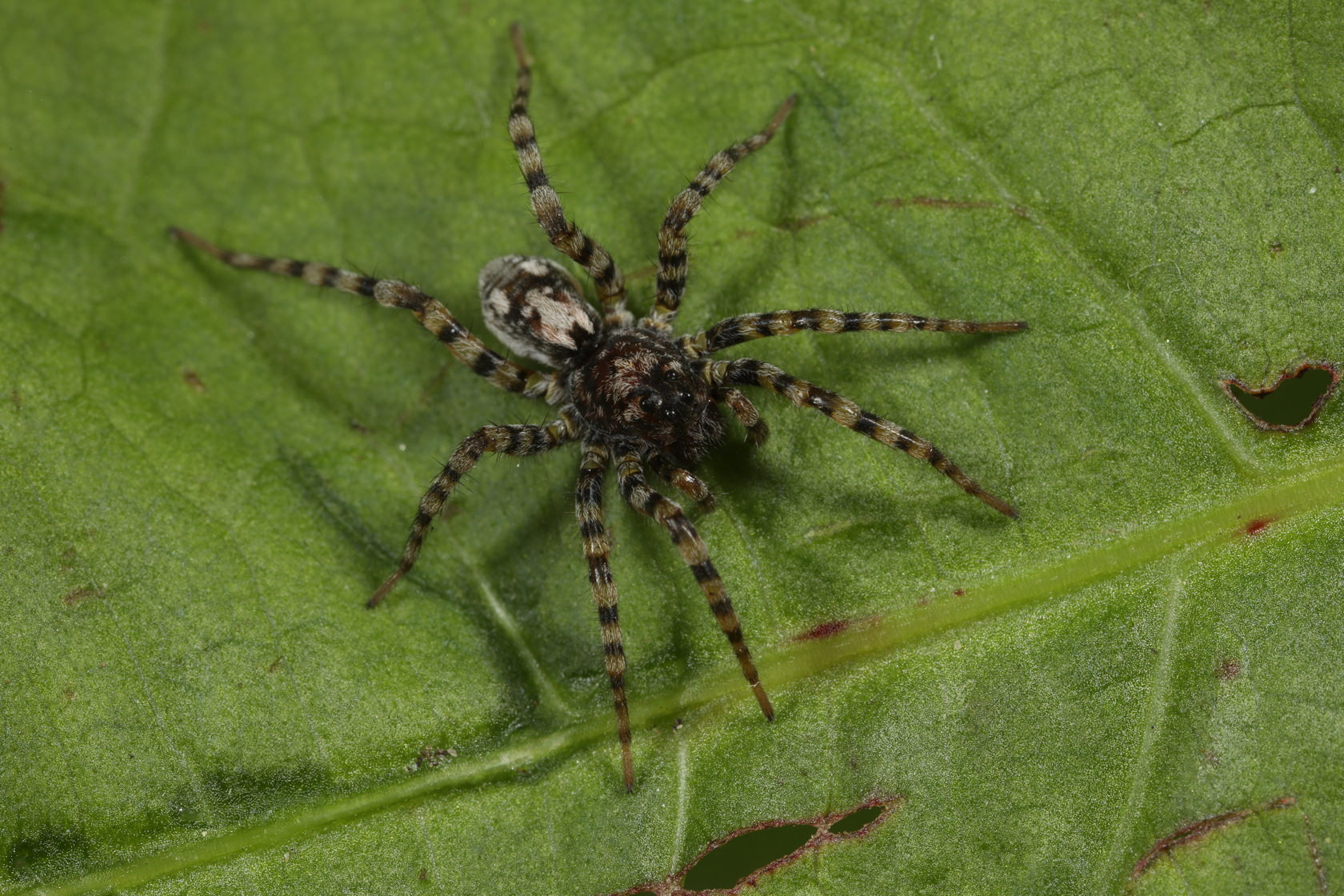
Female wolf spider (Arctosa perita), Findhorn Hinterland, 1st July 2019.
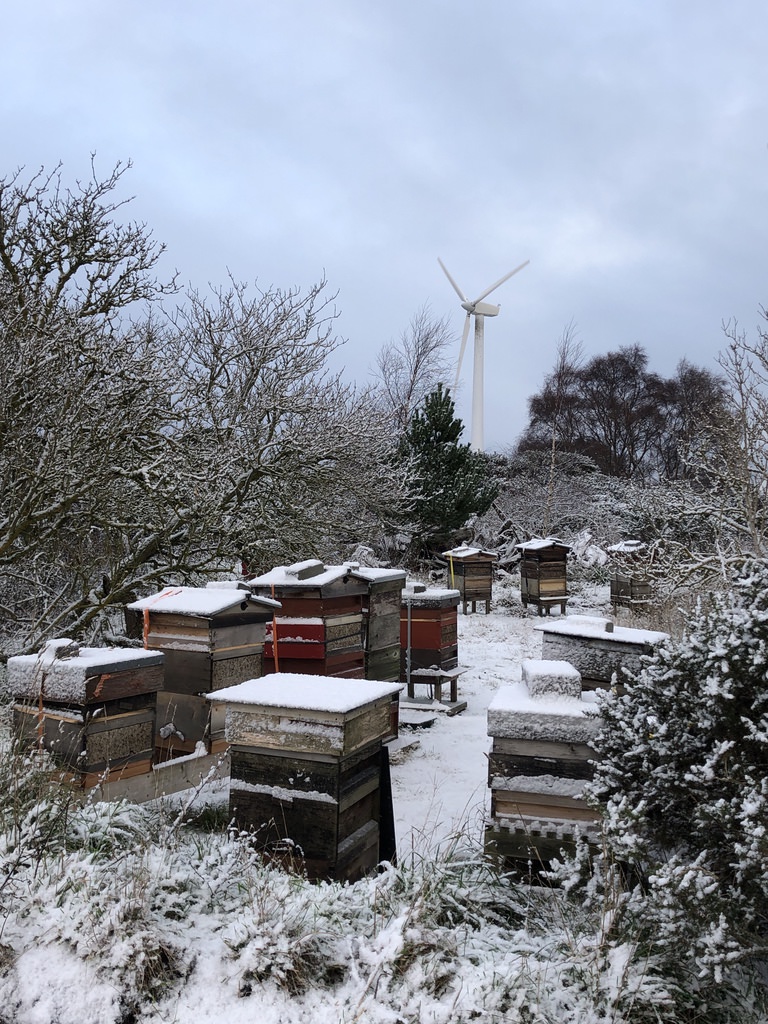













Greetings from the pony field!
With April came spring, the most significant change of season in the pony year: the first spring grass, the end of winter grazing, and a tide of hair flooding out from the field as the woolly winter coat comes off and is replaced by the sleeker and sometimes darker summer coat (prime nest building material!)
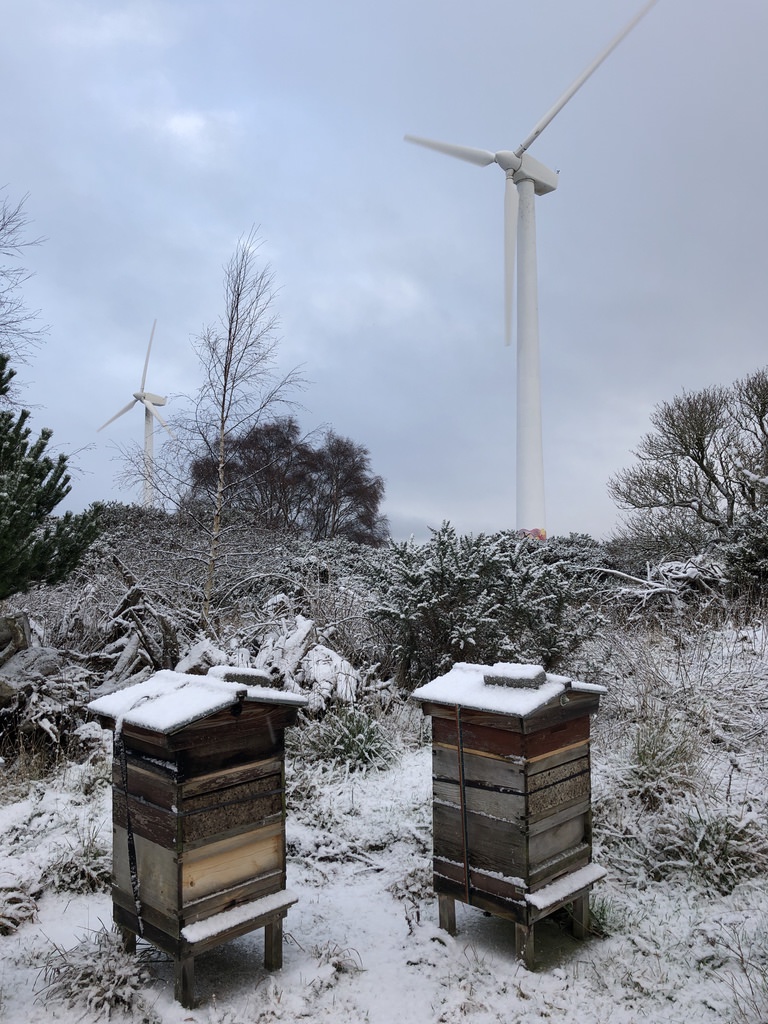
We had a successful six months of landscape management grazing, mostly around the middle wind turbine and opposite the South turbine. The South turbine field was upgraded last autumn with a permanent fence and served us well especially in the two winter weeks when the pony field became too dangerous with snow and ice for both ponies and humans. One very icy morning I didn’t even dare to go into the field but just opened the gate and let the ponies find their own way out, placing every hoof very slowly and carefully, and over to the winter grazing field. I’m glad to say we made it through all the winter weathers with no injuries. Another upgrade that made the winter much easier for humans is the fabulous new hay shed: no more blown off tarpaulins, no more puddles on the haystack, and dry tea breaks too. A big thank you to Jonathan and team!
Freshly green and full of sugar, spring grass is wonderful, very welcome – and can be too much. Ponies have sensitive digestive systems and any change can upset them. Not all breeds can handle sugar: little dark Milo’s Shetland genes mean that sugar can trigger laminitis, a very painful inflammation of the feet. He already stopped winter grazing in March, and by the time this newsletter comes out he will have started to spend mornings (when the grass has the highest sugar content) in his pen to keep him healthy. He is not being starved and neglected but on a carefully monitored diet, and please don’t throw grass and other treats over the fence for him!
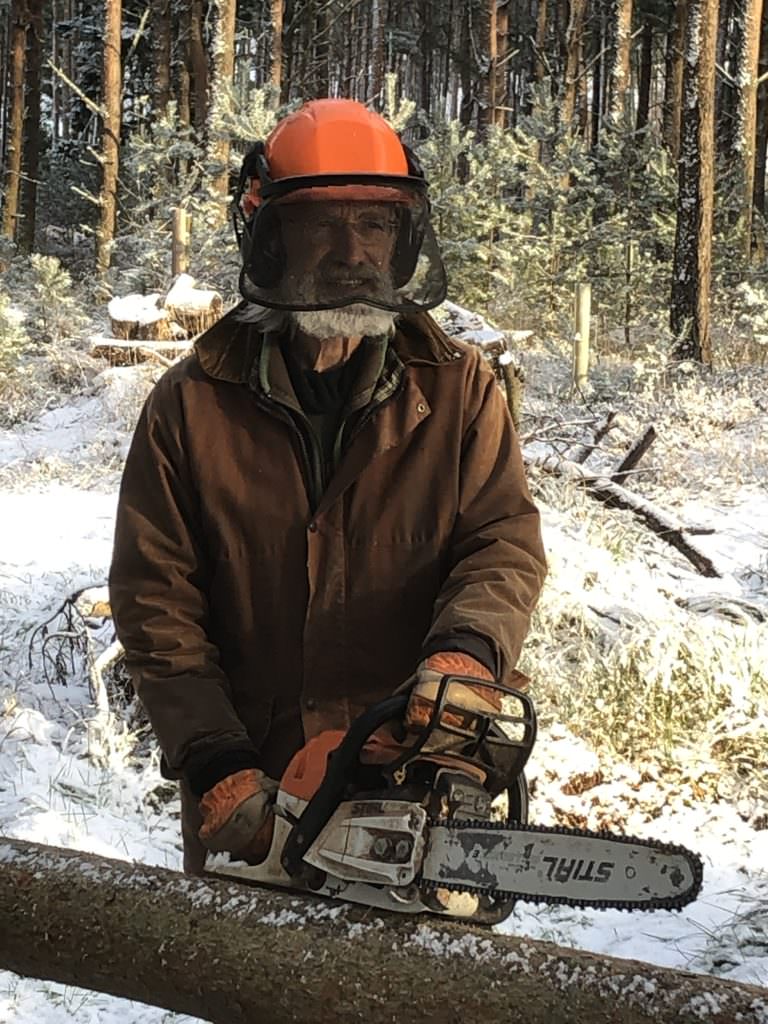
With the spring weather we enjoy going for walks, a great non-riding way of spending time together. You might meet any combination of ponies and humans on the path around the dunes, building up fitness and training. Jock the Appaloosa cob with the dark spots and I will often look like we’re just pottering about or standing in the sun, when what we really do is intensive training in staying calm, focused and confident in the middle of so many distractions both scary and wonderful. After two years on the Hinterland we’re both doing very well and handle dogs, bikes, chain saws and mysterious bright objects like old pros.
Another question we get now that winter is over is: Can we get manure from you?
Yes you can!
Call Kathryn Kusa on 01309 690712 to find out how it works and when you can come, since one of us needs to be there to let you in and show you where to go.
Katharina Kroeber for the pony team