Reforesting Scotland visited the Hinterland for their 2025 Gathering study trip – FHT’s Kajedo Wanderer and Jonathan Caddy gave them an inspiring day at the ecovillage, exploring the highlights of the dunes and woodlands, big and small.
By Reforesting Scotland director Mia Lalanne
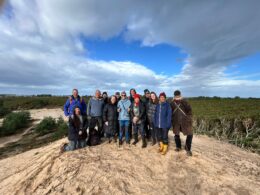
For 27 years, Reforesting Scotland members and directors have gathered on an annual basis, always in a different part of Scotland. While each Gathering serves an important function as the charity’s annual general meeting, it is also a three-day opportunity for connecting with old and new friends; for engaging in a wide range of discussions and practical workshops; and most excitingly, for participating in study trips to learn firsthand about local places and projects.
The moment this year’s Gathering was confirmed for Forres, the directors knew that the neighbouring Park Ecovillage Findhorn would play an outsize role in shaping the 2025 Gathering. However, we could never have expected the generosity, patience and kindness we received. Longtime community member Roger, and an equally gracious neighbour, opened up their hearts and homes to our Building Tour participants. On Friday evening, the pioneering Alan Watson Featherstone braved the wind and rain to deliver a welcome speech that set the scene for the rest of our weekend among the unique Moray Coast landscapes. And as Storm Amy sent our best-laid plans awry, the Findhorn Hinterland Trust (FHT) team did not bat an eye in postponing our highly anticipated study trip until a safer and sunnier time.
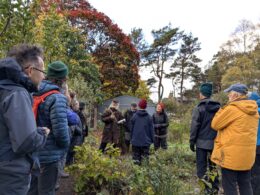
Therefore it was on Sunday morning that FHT land manager Kajedo greeted us outside the Phoenix Shop with a smile and a gentle group meditation. Upon learning that for the majority of our group, it was their first time in the ecovillage, Kajedo insisted on a quick side quest to show us the original caravan site and the new community sanctuary. We heard about the humble beginnings of this now world-famous intentional community, and how key decisions across the decades had been shaped by listening to intuition – as in ‘inner tuition’ – and co-creation with the intelligence of nature.
Next we visited the Hinterland, a mosaic of woodland, grassland and dunes managed by FHT for the last 20 years. The woodland was originally dense stands of Scots pine, Corsican pine, and North American lodgepole pine, planted 80 years ago by the previous landowners. However, FHT is in the process of shaping it into a win-win for all facets of nature – including the human visitors: to date FHT’s work has included building 12 campsite pads, two compost toilets, a shelter, a kitchen tent, a hut, a 250-metre trench for drinking water, and many paths that require continual maintenance. However, Kajedo appeared proudest about something he did not actually have a direct hand in: an area called the Fallen Acres.
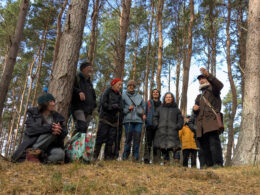
The Fallen Acres were created when a strong storm in 2004 blew down a large section of lodgepole pines at the edge of the woods. With a mature lodgepole pine producing 50 times more seedlings than a native Scots pine, lodgepoles are known to push out indigenous species. For many years FHT had been carefully extracting both mature and seedling lodgepole pines from across the woodland. However, it was the Fallen Acres that showed Kajedo the way forward: true regeneration actually begins at the edges, where it can become ‘wild and woody’ with brambles and raspberries and hazels and other ‘marginal’ things which, Kajedo mused, are not valued enough in today’s society.
Kajedo also suggested that the Fallen Acres might be an example of how every setback – even when it might feel like a disaster or devastation at the time – in fact leads to opportunity. He also reminded us of the most important principle of all, which is familiar to any permaculture student: you must first observe before you change anything – or, as one of the ecovillage’s co-founders put it, you must ‘be still and listen’.
At teatime we were joined by FHT chair Jonathan Caddy, who turned the group’s attention to the surrounding vegetated shingle dunes. He shared about the recent Nature30 award and other incredible achievements and partnerships organised through FHT, which helped progress the wider conversation – and improve the chances of securing funding – for nature regeneration initiatives across Scotland and the world.
Kajedo and Jonathan added they’d also benefited from inviting experts and researchers to visit the Hinterland, as it enabled them to see the land through ‘people who know where and how to look’. For instance, it was through an official lichen survey that a section of the dunes was identified as a Cinderella Site, unique in the world for the number of different lichen species and other extremophiles located there. Jonathan walked our group to that exact area to have a look.
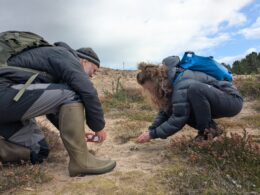
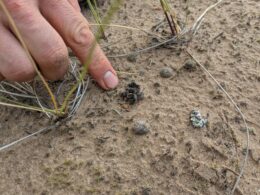
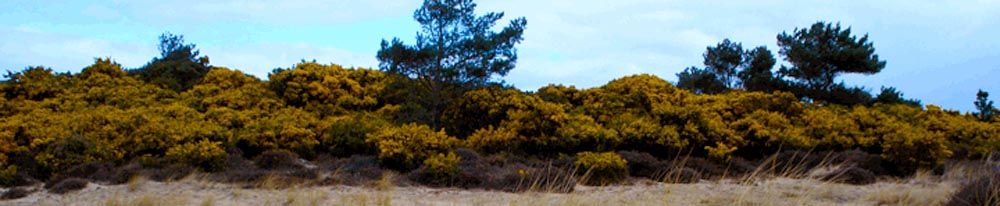
Now armed with the ability to identify the extraordinarily rare sandy earthtongue fungus, we traveled onwards through sandy ridges the FHT team and volunteers had carved through dense gorse. We encountered a burn pile, which Jonathan admitted was a ‘not ideal’ way of getting rid of the gorse – a preferred method would be putting it through a chipper, or perhaps finding a way to use it for insulation or for heating. However, at the moment they simply had to prioritise making a dent on the dense cover of gorse. The landscape was currently 70% woody scrub, when it should be only a minority feature of a healthy dune habitat.
Jonathan led us to the top of a recently cleared dune, from where we could spot the sea behind the unending wall of green. The gorse had capitalised on the progressive settling of the dunes when local plantations, including the nearby Culbin Forest, grew taller and acted as a windbreak. Jonathan pointed out that the gorse today posed enormous risk not just for the dune ecosystem, but also as a fire hazard for the human settlements around the bay.
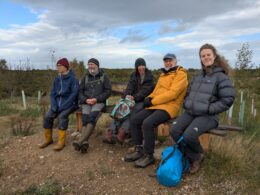
Our group had many questions about how FHT was able to successfully finance their charity’s massive body of work. Jonathan led us to part of the puzzle – a ‘chunky bench’ made by locals and visitors during a workshop, using wood from Hinterland pines milled on-site. FHT generates income from courses, green burials, memberships, and also via the ecovillage’s wind turbines that pay rent to the charity. Jonathan shared that the FHT produced a regular newsletter which anyone interested in learning more about their activities – whether they had attended this study trip or not – were welcome to sign up to. (You can sign up here.)
Kajedo had suggested earlier in the morning that every success is built on at least half a dozen failures, especially when working alongside nature. But for all of Kajedo and Jonathan’s transparency about the complex things they’ve learned along the way, our study trip group headed back to the rest of the Gathering feeling inspired about FHT’s vivid connection, effort, and care for the land we all live on. Several of us agreed there was only one thing left to do: we would need to come back again soon to learn more.










Reforesting Scotland visits the Hinterland
Reforesting Scotland visited the Hinterland for their 2025 Gathering study trip – FHT’s Kajedo Wanderer and Jonathan Caddy gave them an inspiring day at the ecovillage, exploring the highlights of the dunes and woodlands, big and small.
By Reforesting Scotland director Mia Lalanne
For 27 years, Reforesting Scotland members and directors have gathered on an annual basis, always in a different part of Scotland. While each Gathering serves an important function as the charity’s annual general meeting, it is also a three-day opportunity for connecting with old and new friends; for engaging in a wide range of discussions and practical workshops; and most excitingly, for participating in study trips to learn firsthand about local places and projects.
The moment this year’s Gathering was confirmed for Forres, the directors knew that the neighbouring Park Ecovillage Findhorn would play an outsize role in shaping the 2025 Gathering. However, we could never have expected the generosity, patience and kindness we received. Longtime community member Roger, and an equally gracious neighbour, opened up their hearts and homes to our Building Tour participants. On Friday evening, the pioneering Alan Watson Featherstone braved the wind and rain to deliver a welcome speech that set the scene for the rest of our weekend among the unique Moray Coast landscapes. And as Storm Amy sent our best-laid plans awry, the Findhorn Hinterland Trust (FHT) team did not bat an eye in postponing our highly anticipated study trip until a safer and sunnier time.
Therefore it was on Sunday morning that FHT land manager Kajedo greeted us outside the Phoenix Shop with a smile and a gentle group meditation. Upon learning that for the majority of our group, it was their first time in the ecovillage, Kajedo insisted on a quick side quest to show us the original caravan site and the new community sanctuary. We heard about the humble beginnings of this now world-famous intentional community, and how key decisions across the decades had been shaped by listening to intuition – as in ‘inner tuition’ – and co-creation with the intelligence of nature.
Next we visited the Hinterland, a mosaic of woodland, grassland and dunes managed by FHT for the last 20 years. The woodland was originally dense stands of Scots pine, Corsican pine, and North American lodgepole pine, planted 80 years ago by the previous landowners. However, FHT is in the process of shaping it into a win-win for all facets of nature – including the human visitors: to date FHT’s work has included building 12 campsite pads, two compost toilets, a shelter, a kitchen tent, a hut, a 250-metre trench for drinking water, and many paths that require continual maintenance. However, Kajedo appeared proudest about something he did not actually have a direct hand in: an area called the Fallen Acres.
The Fallen Acres were created when a strong storm in 2004 blew down a large section of lodgepole pines at the edge of the woods. With a mature lodgepole pine producing 50 times more seedlings than a native Scots pine, lodgepoles are known to push out indigenous species. For many years FHT had been carefully extracting both mature and seedling lodgepole pines from across the woodland. However, it was the Fallen Acres that showed Kajedo the way forward: true regeneration actually begins at the edges, where it can become ‘wild and woody’ with brambles and raspberries and hazels and other ‘marginal’ things which, Kajedo mused, are not valued enough in today’s society.
Kajedo also suggested that the Fallen Acres might be an example of how every setback – even when it might feel like a disaster or devastation at the time – in fact leads to opportunity. He also reminded us of the most important principle of all, which is familiar to any permaculture student: you must first observe before you change anything – or, as one of the ecovillage’s co-founders put it, you must ‘be still and listen’.
At teatime we were joined by FHT chair Jonathan Caddy, who turned the group’s attention to the surrounding vegetated shingle dunes. He shared about the recent Nature30 award and other incredible achievements and partnerships organised through FHT, which helped progress the wider conversation – and improve the chances of securing funding – for nature regeneration initiatives across Scotland and the world.
Kajedo and Jonathan added they’d also benefited from inviting experts and researchers to visit the Hinterland, as it enabled them to see the land through ‘people who know where and how to look’. For instance, it was through an official lichen survey that a section of the dunes was identified as a Cinderella Site, unique in the world for the number of different lichen species and other extremophiles located there. Jonathan walked our group to that exact area to have a look.
Now armed with the ability to identify the extraordinarily rare sandy earthtongue fungus, we traveled onwards through sandy ridges the FHT team and volunteers had carved through dense gorse. We encountered a burn pile, which Jonathan admitted was a ‘not ideal’ way of getting rid of the gorse – a preferred method would be putting it through a chipper, or perhaps finding a way to use it for insulation or for heating. However, at the moment they simply had to prioritise making a dent on the dense cover of gorse. The landscape was currently 70% woody scrub, when it should be only a minority feature of a healthy dune habitat.
Jonathan led us to the top of a recently cleared dune, from where we could spot the sea behind the unending wall of green. The gorse had capitalised on the progressive settling of the dunes when local plantations, including the nearby Culbin Forest, grew taller and acted as a windbreak. Jonathan pointed out that the gorse today posed enormous risk not just for the dune ecosystem, but also as a fire hazard for the human settlements around the bay.
Our group had many questions about how FHT was able to successfully finance their charity’s massive body of work. Jonathan led us to part of the puzzle – a ‘chunky bench’ made by locals and visitors during a workshop, using wood from Hinterland pines milled on-site. FHT generates income from courses, green burials, memberships, and also via the ecovillage’s wind turbines that pay rent to the charity. Jonathan shared that the FHT produced a regular newsletter which anyone interested in learning more about their activities – whether they had attended this study trip or not – were welcome to sign up to. (You can sign up here.)
Kajedo had suggested earlier in the morning that every success is built on at least half a dozen failures, especially when working alongside nature. But for all of Kajedo and Jonathan’s transparency about the complex things they’ve learned along the way, our study trip group headed back to the rest of the Gathering feeling inspired about FHT’s vivid connection, effort, and care for the land we all live on. Several of us agreed there was only one thing left to do: we would need to come back again soon to learn more.